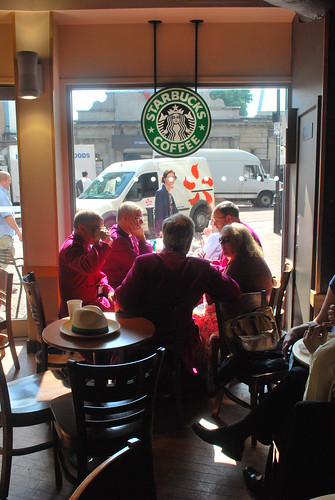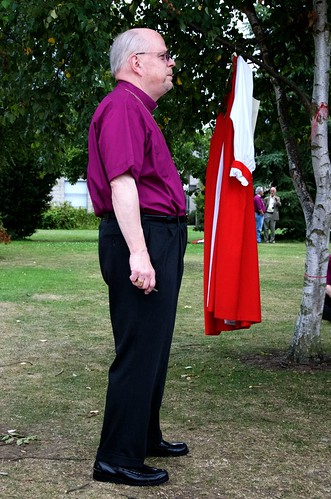
Our inspectors ensure that episcopal garments are harvested only at the peak of ripeness.
please post your own suggested captions!


She said at the Lambeth Conference in Canterbury that men beat women "because they can." She said: "We have 700 men here. Do you think any of them beat their wives? Chances are they do. The most devout Christians beat their wives... many of our bishops come from places where it is culturally accepted to beat your wife."Comparisons are sure to be made to Spong's description of African bishops, at the last Lambeth Conference, to being little more than superstitious animists and witch-doctors, as well as to the ploy by homosexualist activist MacIyalla who claimed (with a similar lack of any evidence whatsoever) to have been attacked and beaten with the connivance of the Nigerian Church and bishop Akinola.
Q: Bishop, you heard Ms. Roskham's accusation today that some bishops in your region beat their wives... would you care to comment?
A: Why certainly. In fact, wife-beating is a common orientation in my country, and we encourage it in our parishes. I myself beat my wife four or five times a day.
Q: Really?
A: Absolutely. We think this practice is essential to the Christian life and so are requiring study of "theories and theologies of wife-beating" in all our seminary curricula, replacing such useless subjects as patristic history or Christology. We have also just passed canon laws saying that no wife-beating postulant may be refused ordination just because he beats his wife, and we are working toward the day when out-of-the-closet wife-beaters will be represented at all levels of our church. After all, we all share the same baptism, therefore wife-beaters have a divine right to be recognized, celebrated and welcomed as deacons, priests and bishops.
Q: Some might suggest that wife-beating is contrary to the teaching of Scripture and Tradition. While Scripture is not explicit in its condemnation of wife-beating -- unlike its condemnation of homosexuality -- it does tell husbands to love their wives as Christ loved the Church. The Scriptural requirements for ordination are clearly incompatible with wife-beating. And under the influence of the Church, wife-beating was actually made grounds for divorce in many late Antique societies (the Eastern Roman Empire, Ireland, etc).
A: Ah, well, the "wife-beating" implicitly or explicitly condemned in Scripture and Tradition is not the same "wife-beating" as we have today. We live in a very different time and culture, and have a deeper understanding of the relationships of wife-beating. So the prohibitions of past days don't apply to our wife-beating at all.
Q: Are you suggesting that the moral law changes over time?
A: Of course. Doesn't everyone know that? Besides, the very fact that there are passages condemning the practice go to show that people were beating their wives even during the patristic and medieval period -- and, since it was going on then, it must be okay now. That was the true church, as intended by Christ, that was beating their wives -- the suppression of the practice simply represents the conspiratorial efforts of an evil, matriarchal culture from which we are only now escaping so as to rediscover our ancient heritage. Wife-beating is an acceptable and wonderful life-style choice, and it is only close-minded bigots and sadophobes such as Ms. Roskam who suggest otherwise.
Q: And so you believe your society and culture has a clearer view of the issue now than the Church did in the past?
A: Absolutely. My contemporary modern culture better understands the practice, and approves it -- so, obviously, we have been given a clear prophetic mandate to reinterpret Scripture and Tradition and to spread Communion-wide this joyful good news of the inclusion and celebration of wife-beaters.
Q: From Roskam's comment, it is clear that this practice and advocacy of wife-beating is straining the bonds of affection within the Communion. Why, some Americans have said that it interferes with their own church's efforts at
evangelizationraising money and suing traditionalists, because of the impression that they are "that wife-beating church".A: Well, I'm sorry they feel that way, but we can hardly cease beating our wives without our wife-beaters being marginalized, and it would be unfair to sacrifice them to some impersonal agenda being imported from abroad. Besides, if we did, our wife-beaters' feelings would be hurt and they'd think that their gifts are being rejected. We have clearly seen the spirit at work in the lives and ministry of people who beat their wives, proving that they are blessed and approved by God. Thus we can see that God's plan calls for the inclusion (and ordination) of all people, regardless of race, gender... or whether or not they beat their wives.
Q: Some people might suggest that wife-beating is a behavior, not an identity, and so oughtn't be compared to race.
A: Ah, well, these people are obviously not current on the latest research on wife-beating. Studies have shown that it is possible that there is some genetic predisposition to violence. Therefore wife-beating is clearly a part of these people's "human nature" and ought not to be criticized or discriminated against. To forbid or condemn that behavior is tantamount to rejecting their identity and humanity... something Jesus would never do. Especially if it is true, as some studies suggest, that he was a wife-beater himself (in his relationship with Mary Magdalene) and ordained several wife-beaters among his first disciples. This is why I am proud to say that our church is fully supportive and inclusive of wife-beaters.
Q: Criticism has been expressed in recent years over how your church has sent members into America and elsewhere to establish chapters of Hitagirltry, the pro-wife-beating organization based in your country, headed by Crude Lou and Samson Tussle.
A: We feel it is our God-given mission to reach out and support our wife-beating brothers in all parts of the world, especially in those places where they are discriminated against by religious or secular forces. Why, in America it is actually possible to be put into prison for wife-beating! We need to let our wife-beating brothers in other parts of the world know that we hear their voices and share their pain. Part of that ministry is to have a presence on the ground to support and encourage them.
Q: Does it trouble you at all that wife-beating is contrary to the tradition of Christian faith and order, the teaching and practice of centuries of Anglicanism, the explicit statements of previous Lambeth meetings, and the consensus of the majority of the Anglican Communion?
A: Not at all. The spirit is clearly doing a "new thing" in helping us value and celebrate wife-beating. The Church has always been called to push the boundaries... so we need to leave behind the comfortable but dated assumptions and practices of the benightened pre-modern past in order to explore the new places to which God is calling us today. Our church is, in that tradition of radical liminality, encountering God by blazing a new way for others in the Communion to follow.
Q: Are you concerned by rumors that the draft Covenant may call for a moritorium on wife-beating?
A: Of course not. The final form of the Covenant is far from established, and there will be several years yet before a draft is proposed for our church to review. Moreover, the Covenant will, explicitly, have no provision either for enforcement or for penalties, so it's not as if anyone can stop our God-given pursuit of this "new thing". Besides, joining the Covenant sub-group within the Anglican Communion will, by all accounts, be a completely voluntary thing anyway. So, no, I'm not concerned that anything will come of these current resolutions: the Covenant isn't a threat to anyone.
I do think that it is disappointing, however, that so much time and energy is being wasted examining the issue of wife-beating when we ought to be focusing on AIDS and the MDGs. That, after all, is the real ministry and mission of the church -- not concerns over what married couples do in the privacy of their own homes.Q: Bishop, thanks for your time.
A: Thank you. It was a pleasure bea.. er, meeting you.
 Rowan Williams is at it again.
I spoke about council and covenant as the shape of the way forward as I see it. And by this I meant, first, that we needed a bit more of a structure in our international affairs to be able to give clear guidance on what would and would not be a grave and lasting divisive course of action by a local church.and insists that this is the only reasonable way forward;
We need to speak life to each other; and that means change. I’ve made no secret of what I think that change should be — a Covenant that recognizes the need to grow towards each other (and also recognizes that not all may choose that way). I find it hard at present to see another way forward that would avoid further disintegration.
good law is about guaranteeing consistence and fairness in a community; and also that in a community like the Anglican family, it can only work when there is free acceptance. Properly understood, a covenant is an expression of mutual generosity.And this means:
Mutual generosity : part of what this means is finding out what the other person or group really means and really needs. The process of this last ten days has been designed to help us to find out something of this — so that when we do address divisive issues, we have created enough of a community for an intelligent generosity to be born.
speak from the heart of our identity as Anglicans; and ultimately from that deepest centre which is our awareness of living in and as the Body of Christ.
What we seek to do in our context is faithfully to pass on what you passed on to us — Holy Scripture, apostolic ministry, sacramental discipline. But what are we to think when all these things seem to be questioned and even overturned? We want to be pastorally caring to all, to be “inclusive” as you like to say. We want to welcome everyone. Yet the gospel and the faith you passed on to us tell us that some kinds of behaviour and relationship are not blessed by God.The "not so traditional believer" replies:
What we seek to do in our context is to bring Jesus alive in the minds and hearts of the people of our culture. Trying to speak the language of the culture and relate honestly to where people really are doesn’t have to be a betrayal of Scripture and tradition. We know we’re pushing the boundaries — but don’t some Christians always have to do that? Doesn’t the Bible itself suggest that?
Our love and our welcome are unreal if we don’t truthfully let others know what has shaped and directed our lives... what they are preaching is fundamentally centered in their experience -- "what has shaped and directed our lives" -- rather than in the revelation of Scripture.
Your decisions make a vast difference to us. In this world of instant communication, our neighbours know what you do, and they see us as sharing the responsibility... Imagine what it means when those neighbours are non-Christians, delighted to find a stick to beat us with. Imagine what it is to be known as the ‘gay church’ in a context where that spells real contempt and danger.And the "not so traditional believers" respond in kind -- to cease their aggressive revisionism on the homosexualist issue would be "a betrayal" of their gay and lesbian members, for it would mean rejecting their "gifts" and instead, by not supporting their sexual and civil rights through full inclusion in the sacramental life of the church (marriage & ordination) would be to put them at risk because "they’re still at risk in our society, still vulnerable to murderous violence."
We want to be generous, and we are hurt that some throw back in our faces both the experience and the resources we long to share. Can you try and see us as fellow-believers struggling to proclaim the same Christ, and to be patient with us?’But for traditional believers this isn't about "hurt feelings"... this isn't even about the violent cultural or religious consequences of certain beliefs. This is about the fact that the "Christ" being proclaimed by the revisionists is not the Christ of Scripture, but some modern relativist invention and fable. And so, no, they cannot "see [you] as fellow-believers struggling to proclaim the same Christ"... because you have made it abundantly clear, by your own statements, beliefs, and actions, that, whatever it is you are "struggling to proclaims", it is NOT the "same Christ."
For the first speaker, the cost of generosity may be accusation of compromise : you’ve been bought, you’ve been deceived by airy talk into tolerating unscriptural and unfaithful policies. For the second speaker, the cost of generosity may be accusations of sacrificing the needs of an oppressed group for the sake of a false or delusional unity, giving up a precious Anglican principle for the sake of a dangerous centralisation.We know from what the ABC has said and done before that he does not fear that differences over Scriptural interpretation or Church practices are fundamentally divisive or un-Anglican. But he does feel that to sacrifice the needs of an oppressed group is to make the whole thing hollow, self-serving and pointless; and that for Anglicanism to adopt any sort of "centralization" would be to abandon what is essentially Anglican and become something else. Meaning that such a compromise by the "not so traditional believers" is far more troubling and un-Anglican, from Williams' point of view anyway, than what is being asked of "traditional believers." So that, even in this already-distorted presentation of the "traditional" voice, his clear sympathies remain with the revisionists.
Indaba is open-ended conversation, which doesn't begin by looking for results or feedback. The final document must be faithful to the indaba process: it will therefore be descriptive of the totality of the engagement which the bishops have undertaken under God.And now the "first draft" -- sort of a brainstormed outline and list of statements, describing the discussions, to include -- has been released.
We believe the scriptures to be primary, but read them informed by tradition and reason and with regard for the cultural context. We find biblical scholarship a helpful tool to unpack the scriptures, but cannot avoid a divergence in interpretation, which leads to confusion.I.e. we agree that Scripture is primary, but disagree completely on how to read them, what assumptions to bring to that study, and what the Scriptures actually say. How typically modern Anglican: "we all agree to statements on the meaning of which we disagree, but that's okay because we've agreed to disagree about what exactly what we've agreed on means."
Anglican worship encourages local freedom and inculturation, but values common structure and common prayer across the Communion. We recognise the relationship between liturgy and doctrine - worship shapes belief.We agree to value a common structure as long as we can freely put completely different things within that structure. Those culturally-influenced differing contents, in turn, shape differing beliefs.
There is a strong desire to stay in communion with one another... There is a strong view that the way forward lies chiefly through deepening: person to person relationships, diocesan partnerships, a sense of belonging and mutual affection.We value our relationship, which is a relationship based on having a relationship.
There seems to be a general acceptance that we shall have a Covenant.Consistent with the above, I predict that this will mean having a Covenant that covenants people to having a Covenant. The interpretation or meaning of anything that Covenant actually says or suggests will, of course, differ wildly from place to place; but that's okay, since everyone agrees to disagree about what is actually meant by that to which they've agreed.
We value the “five marks of mission”, though we would wish to see greater emphasis on ecumenism, peace-making and global mutuality. We recognise that to speak out for social justice is a part of mission.So much for the Gospel.
Reconciliation [there's that Episcopal buzz-word for their current trendy un-scriptural and bankrupt theological crap, which replaces spiritual concerns of sin, salvation, and relationship to God with social justice issues]... The Church needs to be watchful of the migration policies of governments... Demographics and economic decline were identified as factors in some situations. The need to welcome immigrants and those in the urban drift was expressed... The needs which confront the church are many but there is inadequate income for undertaking the mission of the church [yeah... especially those places like the Episcopal church, whose membership is declining faster than any other Christian group, which is driving out and suing members, and which is spending millions of dollars annually on the legal fees required for that self-immolation]... There must also be a compassionate community, the enabling of others by the leadership of the church, and the marginalized must be kept in focus [we all know who the "marginalized" in PEcUSA are... they're the ones who have been kept in focus for 30 years now while others (e.g. traditional and orthodox Anglicans) are driven out. This isn't about bringing the "Good News" to those on the margins, this is about making the abandonment of that Good News by certain marginal groups the central focus of the institution]... HIV and AIDS and other pandemics – The church needs to be involved in advocacy, awareness building, pastoral care, and the provision of health care facilities for those affected...You'll look in vain for any sense in this section of Evangelism as bringing a clear Gospel message of salvation and the Lord Jesus Christ to all the world. No, the "prophetic voice" of this particular mission is:
human rights, environment, migrant workers, HIV and AIDS, and others;
Support those who are isolated in their dioceses by initiatives such as that by Gafcon(I guess this explains the ABC's new 'Global South' group designed to undermine GAFCon) and one positive statement of the substance to which the Communion is supposed to contribute:
Make support for the Millennium Development Goals and support for HIV and AIDS ministry a primary focus.
The MDGs are seen as a very good framework for engaging with social justice issues across the Communion at Provincial, Diocesan and Parish level... Through education at every level (in the Diocese, Parish, Theological institutions and Schools), formally and informally, social justice issues should be addressed regularly and systematically. As Bishops, we must model and encourage others to live out their faith in Christ in a way which demonstrates our commitment to these issues. Taking due regard of local contexts, we commit ourselves to advocating and lobbying (government, agencies, business, ecumenical, inter-faith partners and any other appropriate agencies or bodies) on the many issues of social justice we find in our world. We commit ourselves to discerning and interpreting local needs in a way that leads to action, because this is being prophetic. The Bishops role in all of the above is to enable communities of faith to be agents of transformation and reconciliation.


The failure to respond presents us with a situation where if the three moratoria are not observed, the Communion is likely to fracture. The patterns of action currently embraced with the continued blessings of same-sex unions and of interventions could lead to irreparable damage.No, REALLY? I never would have guessed.
BREAKING: Windsor Continuation Group announced that the sun rose today. Reporters shocked; liberals scandalized.
In the period leading up to the establishment of a covenant, however, there are urgent issues which need addressing if we are going to be able to get to the point where such a renewal of trust even becomes possible.Golly, where I have I heard that before? Oh yeah -- the primates at Dar Es Salaam a year and a half ago.
The scheme proposed and the undertakings requested are intended to have force until the conclusion of the Covenant Process and a definitive statement of the position of The Episcopal Church with respect to the Covenant.
the swift formation of a 'Pastoral Forum' at Communion level to engage theologically and practically with situations of controversy as they arise or divisive actions that may be taken around the Communion.Hang on, this also sounds familiar.
The Primates will establish a Pastoral Council to act on behalf of the Primates in consultation with The Episcopal Church.The WCG's Forum must have members appointed by the ABC and represent points of view representing the "breadth" of the Communion as a whole. (I.e. it must have incorporated into its structure precisely the same incoherence and incompatibility which has paralyzed the Communion... so that by representing everyone it can be sure to accomplish nothing.)
The President of such a Forum would be the Archbishop of Canterbury, who would also appoint its episcopal chair, and its members. The membership of the Forum must include members from the Instruments of Communion and be representative of the breadth of the life of the Communion as a whole.That, too, sounds rather familiar.
This Council shall consist of up to five members: two nominated by the Primates, two by the Presiding Bishop, and a Primate of a Province of the Anglican Communion nominated by the Archbishop of Canterbury to chair the Council.
The Pastoral Forum should be empowered to act in the Anglican Communion in a rapid manner to emerging threats to its life, especially through the ministry of its Chair, who should work alongside the Archbishop of Canterbury in the exercise of his ministry. The Forum would be responsible for addressing those anomalies of pastoral care arising in the Communion against the recommendations of the Windsor Report. It could also offer guidance on what response and any diminishment of standing within the Communion might be appropriate where any of the three moratoria are broken.Now that sure sounds a lot like:
negotiate the necessary structures for pastoral care which would meet the requests of the Windsor Report (TWR, §147–155) and the Primates’ requests in the Lambeth Statement of October 2003... authorise protocols for the functioning of such a scheme, including the criteria for participation of bishops, dioceses and congregations in the scheme... monitor the response of The Episcopal Church to the Windsor Report... consider whether any of the courses of action contemplated by the Windsor Report §157 [Should the call to halt and find ways of continuing in our present communion not be heeded, then we shall have to begin to learn to walk apart. We would much rather not speculate on actions that might need to be taken if, after acceptance by the primates, our recommendations are not implemented] should be applied to the life of The Episcopal Church or its bishops, and, if appropriate, to recommend such action to The Episcopal Church and its institutions and to the Instruments of Communion... take whatever reasonable action is needed to give effect to this scheme and report to the Primates.
 to monitor the situation and, if things don't change, "offer guidance on what response and any diminishment of standing within the Communion" should result.
the complete cessation of a) the celebration of blessings for same-sex unions, b) consecrations of those living in openly gay relationships, and c) all cross border interventions and inter-provincial claims of jurisdiction.And its threats of "discipline" (even if they amount to nothing more than proposing a discussion about the possibility of forming another committee to discuss the possibility of discipline) apply equally as well:
It could also offer guidance on what response and any diminishment of standing within the Communion might be appropriate where any of the three moratoria are broken.
We are encouraged by the planned setting up of the Communion Partners initiative in the Episcopal Church as a means of sustaining those who feel at odds with developments taking place in their own Province but who wish to be loyal to, and to maintain, their fellowship within TEC and within the Anglican Communion.I've already pointed out, by examining the details of PEcUSA's CPP program and membership, just what an empty, meaningless shell it is -- nothing more than a celebrated version of existing policy. Yet such emptiness is, apparently, exactly what the WCG is praising and encouraging.
 continue to offer simply more of the same: talk and no action, endless committees, and vague, substance-less, meaningless, impotent hand-waving at irrelevant and unenforceable "consequences". Committees forming committees forming committees...
Last Monday, at the Lambeth Conference, Bishop Winston Halapua from Polynesia spoke about a meeting of churches from various Pacific islands where the subject for discussion had been neither social justice nor personal ethics, but the bare fact of rising ocean levels. Within a very few years, the likelihood is that several small islands will simply become uninhabitable.
Nothing could have brought home more directly the issue that the conference discusses this Saturday – the church's responsibility for the environment. While scepticism about climate change is still given astonishing prominence in some western media, the day-to-day reality of rising water levels is not a matter of debate for our colleagues in the Pacific. Part of the importance of the Lambeth Conference to us all in the Anglican Church is that it lets us hear these things in first hand detail.
 Okay, archbishop... but if anyone has served or eaten beef at the Lambeth Conference, I'm afraid we won't be able to take your concern as genuine. After all, your buddy Dr. Schori already warned us in her theologically profound Easter sermon this year:
When atmospheric warming, due in part to the methane output of the millions of cows we raise each year to produce hamburger, begins to slowly drown the island homes of our neighbors in the South Pacific, are we truly sharing good news?
So fear not, keep looking, and give thanks that when you find a glimpse of the kingdom of heaven, it is around us, even if it smells pretty fishy or whether it sounds like a riot in the wee hours of the morning.The Episcopal church smells of death and decay, rocking with the shrill sounds of conflict and dissension.
 Welcome to Dr. Schori's vision of the Kingdom of Heaven.
 he is the head; and the prophet that teacheth lies, he is the tail. For the leaders of this people cause them to err; and they that are led of them are destroyed. Therefore the Lord shall have no joy in their young men, neither shall have mercy on their fatherless and widows: for every one is an hypocrite and an evildoer, and every mouth speaketh folly. For all this his anger is not turned away, but his hand is stretched out still. For wickedness burneth as the fire: it shall devour the briers and thorns, and shall kindle in the thickets of the forest, and they shall mount up like the lifting up of smoke. Isaiah 9
Then Jesus said unto them, Verily, verily, I say unto you, Except ye eat the flesh of the Son of man, and drink his blood, ye have no life in you. Whoso eateth my flesh, and drinketh my blood, hath eternal life; and I will raise him up at the last day. John 6
I have waited long enough and if something of massive global proportions does not happen in the very immediate future, then I will have lost faith in our conservative leadership once more and I will leave my very conservative TEC diocese for a non-denominational church or perhaps I’ll even quit going to church all together.
 scribes and Pharisees, hypocrites! for ye compass sea and land to make one proselyte, and when he is made, ye make him twofold more the child of hell than yourselves... Ye blind guides, which strain at a gnat, and swallow a camel. Woe unto you, scribes and Pharisees, hypocrites! for ye make clean the outside of the cup and of the platter, but within they are full of extortion and excess. Thou blind Pharisee, cleanse first that which is within the cup and platter, that the outside of them may be clean also. Woe unto you, scribes and Pharisees, hypocrites! for ye are like unto whited sepulchres, which indeed appear beautiful outward, but are within full of dead men's bones, and of all uncleanness.... Ye serpents, ye generation of vipers, how can ye escape the damnation of hell? Matthew 23
That’s certainly not within my purview. He’s (Bishop Robinson) the bishop of the diocese of New Hampshire and such a response would be a matter between him and his diocese and certainly not anything I would expect.How about dem apples, eh? When a diocese does something she doesn't like -- such as upholding traditional Christian belief, or even failing to aggressively persecute those who do -- she's happy to storm in and start shoving people around. But when it's a fellow relativist and apostate (and particularly one who embodies PEcUSA's homosexualist heresy)... ah, all of a sudden she's a hands-off administrator and stickler for protocol.
 Good Mr. Spock |
|
 Evil Dr. Schori |  Eviler Dr. Schori Eviler Dr. Schori |
Liberals will be warned that they face being expelled from the heart of Anglicanism unless they respect the ban, The Sunday Telegraph has learnt.This is the third and last installment of the dreaded Windsor Continuation Group, which we've mentioned before.
to work on the unanswered questions arising from the inconclusive evaluation of the primates to New Orleans and to take certain issues forward to Lambeth. This will feed in to the discussions at Lambeth about Anglican identity and the Covenant process;... it will also have to consider whether in the present circumstances it is possible for provinces or individual bishops at odds with the expressed mind of the Communion to participate fully in representative Communion agencies, including ecumenical bodies... it will thus also be bound to consider the exact status of bishops ordained by one province for ministry in another.Not nearly as scary when you see what it's actually doing, is it -- it's yet another Anglican committee commissioned to examine the status quo.
Until a consensus is reached, the American and Canadian churches must refrain from consecrating more homosexual bishops and carrying out blessing services for same-sex couples, the paper says. If they do not, they will face being pushed to the margins of the communion and find themselves excluded from the councils that are central to the governance of the Church. The African churches, which oppose having practising homosexuals in the clergy, will be told that they must stop intervening in the affairs of other churches as their actions are deepening the rift.
Sound familiar? It should. The Windsor Continuation Group is, after nearly four years of deep study and reflection, suggesting that everybody really ought to do what the Windsor Report said they should do in the first place. (I'm glad we had yet another committee, and more time and money spent, to bring us such a stunning insight.) And I'm sure PEcUSA and Canada will assure us, yet again, that they are complying... and the ABC will set up yet another commission to assure us that, yes, they are indeed complying.The Conference has never been a lawmaking body in the strict sense and it wasn't designed to be one: every local Anglican province around the world has its own independent system of church law and there is no supreme court.These aren't councils central to the governance of each jurisdiction -- each jurisdiction can do whatever the smeg it wants, without reference to these "central" councils and conferences. Heck, in the case of PEcUSA, they've spent over 30 years doing whatever the smeg they want without reference to their own councils and canons! So it's not like there's any substance to this threatened penalty.
 All this will, of course, accomplish no more than it did last time -- i.e. nothing at all. And, face it, even if something were to be implemented and enforced, the "penalty" for continuing to ignore the suggestions amounts to, basically, nothing. Nothing, that is, except for giving everyone a chance to reassure everyone back home that something is being accomplished. "See, we're making progress. Stop worrying and keep sending in the money!"
 and shocked and hurt yet again, when after another four years of more vague talking, ignored resolutions, and blatantly dishonest claims of compliance... nothing continues to happen.
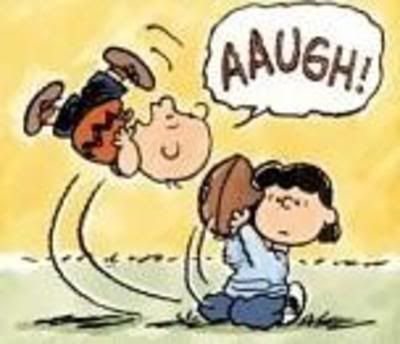
We observe here that there have been calls for moratoria with regard to blessings of same sex relationships, consecration of non-celibate homosexuals and the extra-jurisdictional interventions. And we renew these calls.Come on Charlie Brown, I'll hold it in place this time. Really I will.
to produce a statement of the principles of canon law common to the churches, and to examine shared problems and possible solutions.This mission is based on the notion that (as was said in 2002)
 I guess -- given that we have an "Anglican Communion" that is neither Anglican nor a Communion; a Conference designed (at significant expense) to produce a statement announcing that everyone agreed a Conference had happened; and the on-going development of a Covenant which won't be a Covenant (but just a voluntary non-binding association) -- that having a "Code of Canon Law" that isn't a code and isn't law actually makes perfect Anglican sense.
 Rabbit outside the Templeman Library, University of Kent
 Rabbits examining an ACNS photographer
 Back before Lambeth started, I examined the stages of the indaba process, including the observation:
1. Meet in indaba groups for conversation and "listening".lis·ten (lĭs'ən) intr.v.
a. Conservative - attending to another point of view in an effort to understand
b. Liberal - outward passivity during a period of time in which you think about what to say next, ignoring any noise which might distract you.
Q: How is your indaba group?So much for "unity in diversity"... in PEcUSA we don't have diversity. Or, where we do, we're crushing, inhibiting, deposing and suing it. And not only do we enforce the party line, we give you a memo to read off so you can inflict it on others in a coordinated attack! Gotta keep everyone on message. All the more effective when your party (representing perhaps 2% of the world's Lambeth-recognized Anglicans, and dropping) comprises 25% of the attendees.
A:“Well, the funny thing is,” began one bishop, “The Americans here have this cheat sheet that they use in our group. It has statements on it that justify their decisions in the last two conventions that led to the consecration of Gene Robinson and same-sex marriage. It is a prioritized list of talking points and the one in our group reads off this thing every day.”
Enclosed you will find two sample narratives that were initiated during our March meeting 2008 session with Macky Alston of Auburn Seminary. The suggestions made by the House of Bishops were collected, and Bishops Ed Little, Michael Curry, Neil Alexander, Mike Smith, Cate Waynick, and I [Clay Matthews] worked with Neva Rae Fox to create the two narratives that you will find in this section.The idea is that you have a "core message" which has three "supporting ideas", each of which has three "supporting points". This way, all your points underline one of three ideas which, in turn, communicate the core message.
1. At the Lambeth Conference, the bishops of the Anglican Communion renew our deep unity in Christ.Sounds well and good... until you look at the details. Then you find (as the ACI's Rev. Turner points out) that
2. When Anglicans work together through the power of the Holy Spirit, we change the world.
The TEC memo is in fact proposing a post modern, de-centered church joined not by mutual recognition of belief and practice but by allegiance to a common mission.... The implication is that the mission of the church has nothing to do with the matters that now so divide the Communion—that we can do mission while in fundamental disagreement about the content of the Christian gospel... Those of us who look to our bishops to speak truthfully about our real circumstances can only hope and pray that the incoherence of what TEC is proposing will be pointed out in no uncertain terms.
The Conference this year has two key points of focus: strengthening the sense of a shared Anglican identity among the bishops from around the world, and helping to equip bishops for the role they increasingly have as leaders in mission.This got me wondering... just who beside the Episcopal bishops may be using these talking points? We certainly heard about "unity in diversity" in Lambeth's opening sermon.
signals a hardened position on the part of TEC’s Episcopal leadership that runs counter to the spirit the Archbishop of Canterbury has asked to guide the bishops in their deliberations—a spirit of mutual subjection in Christ that is open to correction.Certainly there is no -- and never has been -- attitude of "mutual subjection in Christ" or any "open[ness] to correction" among PEcUSA's heretical and apostate leadership and bishops. But I don't think this represents "counter to the spirit the Archbishop of Canterbury has asked to guide the bishops."
_NTRYTITL_ @ _NTRYDATE_
_NTRYSNIP_